
Basic Concepts
Spiral wound gaskets are static sealing gaskets formed by alternately spirally winding a thin metal strip and a flexible non-metallic filler strip, then securing them with spot welds. They are the most commonly used semi-metallic sealing components for flanges, valves, and pressure vessels, achieving pressure-resistant sealing through a combination of metal resilience and filler sealing.
The metal strips are typically V-shaped or W-shaped steel, while the non-metallic strips serve to provide filling, cushioning, and sealing functions.
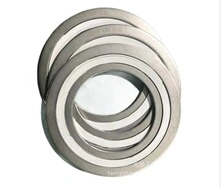
Advantages of Spiral Wound Gasket
1. Excellent resilience: The V-shaped metal strip offers good elasticity, compensating for thermal expansion and contraction, bolt relaxation, and minor face deformation to ensure stable sealing performance.
2. Wide temperature and pressure range: Suitable for low-to-high temperature and medium-to-high pressure conditions, as well as thermal cycling environments.
3. Corrosion resistance options: Flexible selection of metal and non-metal materials provides resistance to acids, alkalis, oils, steam, and chemical media.
4. Strong sealing adaptability: Capable of compensating for flange surface roughness and minor edge warping.
5. Convenient installation and removal, high cost-effectiveness, and easy maintenance or replacement.
Main Types of Spiral Wound Gasket
1. By Structural Configuration:
(1) Basic Type (No inner or outer rings): Pure wound body; primarily used for tongue-and-groove flanges.
(2) Inner Ring Type: Features a solid metal inner ring to prevent the gasket from being blown out by internal medium pressure; primarily used for male-female (raised-recessed) flanges and high-pressure piping.
(3) Outer Ring Type (Centering Ring): Features a metal outer centering ring to ensure proper positioning and prevent gasket misalignment; the most common type and standard for Raised Face (RF) flanges.
(4) Inner & Outer Ring Type (Reinforcing Rings): Features both inner and outer metal rings; the preferred choice for high-pressure, high-temperature, and highly corrosive service conditions.
2. By Non-Metallic Filler Material:
(1) Graphite Filler (Flexible Graphite): High-temperature resistance and good thermal conductivity; widely used in steam, hot oil, boiler, and petrochemical applications.
(2) PTFE Filler: Excellent resistance to acid and alkali corrosion; used for chemical piping handling strong acids and alkalis.
(3) Asbestos/Non-Asbestos Fiber: Suitable for low-temperature water and general gases; non-asbestos materials are commonly used as eco-friendly alternatives to asbestos.
(4) Mica Filler: For ultra-high temperatures (>600°C); used in high-temperature flue ducts and furnace flanges.
3. By Metal Strip Material:
(1) 304/316 Stainless Steel: General-purpose corrosion resistance;
(2) 321 Stainless Steel: High-temperature resistance;
(3) Hastelloy, Monel: Specialized chemical applications involving severe corrosion.
Applications of Spiral Wound Gasket
1. Petrochemical: Reactors, heat exchangers, pipeline flanges, and tower seals;
2. Thermal Power: Boilers, steam turbines, high-temperature steam valves, and flue duct flanges;
3. Oil & Gas Storage and Transport: Oil and gas transmission pipelines and storage tank manholes;
4. Coal Chemical/Fine Chemical: Acid/alkali reaction vessels and anti-corrosion piping (PTFE-wound gaskets);
5. Shipbuilding & Metallurgy: High-temperature furnace bodies and hydraulic oil/gas flanges;
6. Water Supply/Drainage & HVAC: High-temperature hot water and steam pipeline network flanges.
If you would like to find out more about spiral wound gasket, please contact us at export@weitengroup.com, www.weitengroup.com.
MOBILE / WHATSAPP86-18561739639
ADDRESSNo.27, Baoyuan Rd, Gaoxin District, Qingdao,China.
 WEITEN GROUP
Copyright © 2026 by WEITEN GROUP All Rights Reserved Designed by HUISHANG MEDIA