
From a technical perspective:
Under Chinese national standards (GB), ductile iron is typically designated as QT400-15, QT400-18, etc. Here, "QT" is the abbreviation for ductile iron (spheroidal graphite iron), "400" indicates the tensile strength, and "15" or "18" indicates the elongation percentage. International designations vary widely; for example, European standards use EN-GJS-400-15/18, while German standards use grades such as GGG40, GGG40.3, and GGG50.
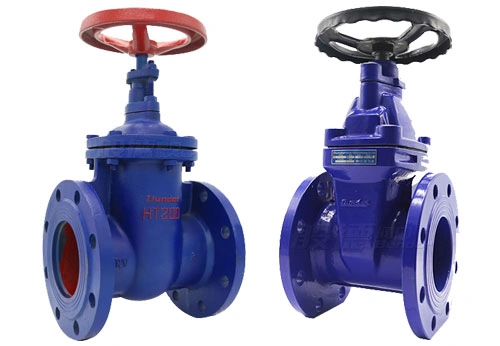
Gray cast iron is typically designated under Chinese national standards as HT150, HT200, HT250, etc. Here, "HT" is the abbreviation for gray cast iron, and "150" indicates the tensile strength. German standards designate gray iron grades as GGG15, GGG20, GGG25, GGG30, etc.
In the microstructure of gray cast iron, graphite exists in flake form, whereas in ductile iron, it exists in spherical (nodular) form. Gray cast iron has low strength and plasticity (flake graphite disrupts the matrix and causes stress concentration) and high brittleness, though it offers good vibration-damping properties; it is primarily used for parts with low strength requirements. In contrast, spherical graphite minimizes disruption to the matrix and reduces stress concentration, allowing the matrix's properties to be fully utilized while providing a degree of plasticity and good toughness.
Therefore, the strength of ductile iron is significantly higher than that of gray cast iron!
If you need to distinguish between ductile iron valves and gray iron valves on-site:
1. Examine the machined surface: Gray iron appears gray with a dull luster and a relatively rough surface. Ductile iron also appears gray but has a brighter luster than gray iron, though the surface roughness is similar.
2. Filing test: Gray iron offers low resistance to filing and produces a "swish-swish" sound; it rarely sticks to the file. The filings are grayish-black with a few silvery-white specks; close inspection reveals uneven particle sizes, predominantly fine dust and small particles. Rubbing the filings between fingers easily stains the fingers black. Ductile iron: Resistance during filing is slightly higher than that of gray iron, and a distinct "swish-swish" sound is audible; the material rarely clogs the file. The filings are grayish-black with fine, bright specks; particle sizes vary, though larger particles predominate. Rubbing the filings between one's fingers leaves a black stain, though less intense than that left by gray iron.
3. Listen to the sound upon striking—Gray iron: The sound is low-pitched and decays very quickly. Ductile iron: The sound is crisp with a lingering resonance, though the duration is relatively short.
For more information on valves, please visit the WEITEN Valve official website at www.weitengroup.com.
MOBILE / WHATSAPP86-18561739639
ADDRESSNo.27, Baoyuan Rd, Gaoxin District, Qingdao,China.
 WEITEN GROUP
Copyright © 2026 by WEITEN GROUP All Rights Reserved Designed by HUISHANG MEDIA