
Introduction to Stainless Steel Knife Gate Valves
The opening and closing component of a knife gate valve is a "gate" (or disc) that moves perpendicularly to the direction of fluid flow. Knife gate valves are designed for fully open or fully closed operation only; they cannot be used for flow regulation or throttling. The gate typically features two sealing faces. There are two common methods for forming the wedge-shaped sealing surfaces of a gate valve: depending on the valve's specifications, the wedge angle is typically 5 degrees. Wedge-type knife gate valves can be manufactured as a single, solid piece—known as a "rigid gate." Alternatively, the gate can be designed to allow for slight deformation—known as an "elastic gate"—to improve its sealing performance and compensate for any angular deviations in the sealing surfaces resulting from the manufacturing process. When a knife gate valve closes, the sealing surfaces may rely solely on the pressure of the medium itself to achieve a seal; this "self-sealing" mechanism utilizes the medium's pressure to press the gate against the sealing surface of the valve seat, thereby ensuring a tight seal. However, most knife gate valves utilize "forced sealing," meaning that when the valve closes, the gate is mechanically forced against the valve seat by external pressure to ensure the integrity of the seal.
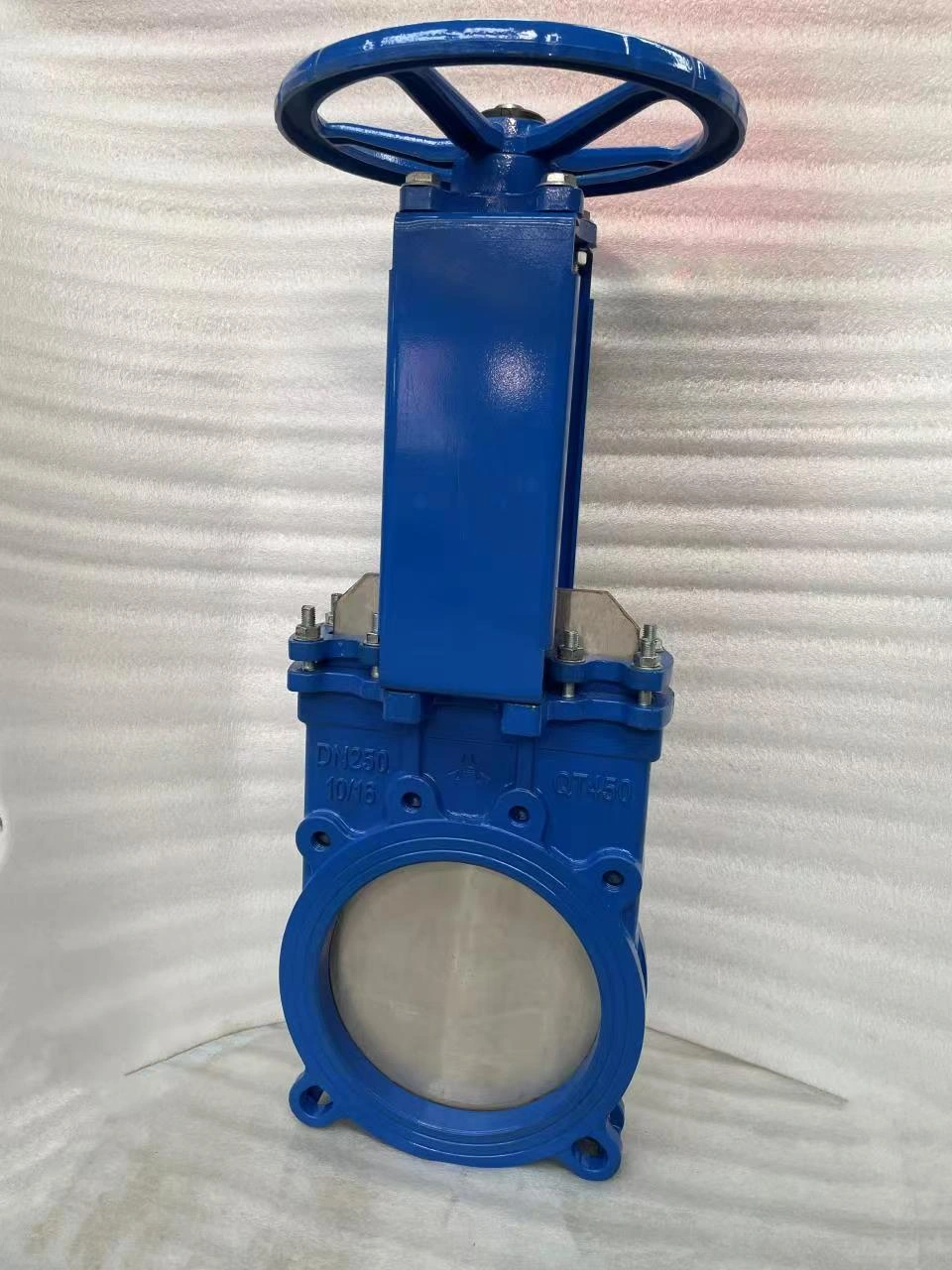
Stainless Steel Knife Gate Valves: Handling Various Media
As the name suggests, a knife gate valve features a gate (valve disc) with a beveled, knife-like edge at its bottom. This design serves the function of "cutting through" the medium, allowing the valve to effectively sever the flow and achieve a complete shut-off. These valves are typically used to control the flow of media such as pulp, ash, chemicals, sewage, food products, and other substances. The standard operating pressure range is typically up to 1.6 MPa. While generally suitable for temperatures below 120°C, the valves can be adapted for higher-temperature applications through the use of specialized materials. In terms of sealing performance requirements, valves are categorized into "soft-sealed" and "hard-sealed" types. Depending on the specific grade and testing standards, soft-sealed valves can achieve "zero leakage," whereas hard-sealed valves may allow for a minimal, permissible amount of leakage.
This valve offers convenient operation, smooth opening and closing, and reliable, flexible movement. Its maintenance is straightforward; the valve components are simple in design, the sealing structure is rational, and the replacement of sealing rings is both easy and practical.
Stainless Steel Knife Gate Valves: Overview
1.Compact Structure: The valve features a short face-to-face dimension (installation length), which can significantly reduce the overall weight of the piping system.
2.Space Efficiency: It occupies minimal effective space and provides effective structural support to the piping components, thereby reducing the likelihood of pipe vibration.
3. Corrosion Resistance: The gate is constructed from austenitic stainless steel, which significantly enhances its corrosion resistance. This material selection effectively prevents corrosion-induced leakage at the gate's sealing interface.
4. The PTFE seal ensures reliable sealing, and operation is light and flexible.
5. The knife gate valve can effectively cut through various impurities present in the medium.
If you would like to find out more about valves or purchase other products, please contact us at fluid@weitengroup.com, www.weitengroup.com
MOBILE / WHATSAPP86-18561739639
ADDRESSNo.27, Baoyuan Rd, Gaoxin District, Qingdao,China.
 WEITEN GROUP
Copyright © 2026 by WEITEN GROUP All Rights Reserved Designed by HUISHANG MEDIA