
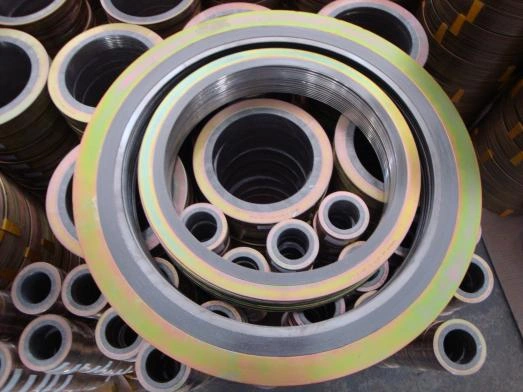
spiral wound gaskets have emerged as critical components in industrial sealing applications, offering unparalleled performance in high-temperature and high-pressure environments. Their unique construction of alternating metal and filler materials has established them as the preferred sealing solution for industries ranging from petrochemicals to power generation and aerospace.
spiral wound gaskets are high-performance sealing elements manufactured by precision-winding pre-formed metal strips with soft filler materials into a distinctive V-shaped cross-section. This innovative structure creates multiple sealing barriers that can withstand extreme operating conditions while compensating for minor flange surface imperfections.
Key characteristics include:
Multi-layer construction with alternating metal and filler layers
V-shaped winding pattern for optimal compression and recovery
Available with or without inner and outer reinforcement rings
Customizable materials for specific application requirements
spiral wound gaskets offer exceptional technical capabilities:
Temperature Resistance:
Standard range: -250°C to 540°C
Special configurations up to 1000°C
Pressure Capability:
Vacuum to 25 MPa (3600 psi)
Excellent performance in pressure cycling conditions
Mechanical Properties:
Superior spring-back characteristics
Excellent creep resistance
Maintains seal integrity during thermal cycling
The versatility of spiral wound gaskets lies in their material adaptability:
Metal Windings:
304/316 Stainless Steel: General purpose applications
Titanium: Chloride-rich environments
Nickel Alloys (Inconel, Monel): High-temperature corrosion resistance
Duplex Stainless Steels: Stress corrosion cracking resistance
Filler Materials:
Flexible Graphite: Universal chemical resistance, -200°C to 850°C
PTFE: Excellent chemical resistance, -260°C to 260°C
Mica: High-temperature steam applications
Ceramic Fiber: Extreme temperature environments
spiral wound gaskets serve critical functions across multiple sectors:
Oil & Gas Industry:
Wellhead equipment and Christmas trees
Pipeline flanges and refinery installations
LNG processing facilities
Power Generation:
Steam turbine systems
Boiler connections and heat exchangers
Nuclear power plant components
Manufacturers offer comprehensive customization options:
Standard Features:
Sizes from DN15 to DN1200 (½" to 48")
Various thicknesses: 3.2mm, 4.5mm, and 6.5mm
Multiple winding densities for different pressure classes
Selection Considerations:
Operating temperature and pressure ranges
Chemical compatibility with process media
Flange type, surface finish, and bolting
Regulatory and certification requirements
Maintenance accessibility and service intervals
spiral wound gaskets manufactured to international standards:
ASME B16.20: Pipe flanges and gaskets
API 601: Metallic gaskets for piping
ISO 9001:2015 Quality management systems
PED 2014/68/EU: Pressure equipment directive
NACE MR0175: Sulfide stress corrosion resistance
spiral wound gaskets represent the pinnacle of sealing technology, combining sophisticated engineering with practical performance benefits. Their ability to perform in the most demanding applications while providing long-term reliability makes them an indispensable component in modern industrial operations.
If you would like to find out more about spiral wound gasket or purchase other products, please contact us at sales@weitengroup.com, wwww.weitengroup.com.
MOBILE / WHATSAPP86-18561739639
ADDRESSNo.27, Baoyuan Rd, Gaoxin District, Qingdao,China.
 WEITEN GROUP
Copyright © 2026 by WEITEN GROUP All Rights Reserved Designed by HUISHANG MEDIA