
Ceramic fiber blankets commonly known as aluminum silicate fiber blankets, are a mainstream lightweight refractory and thermal insulation material.
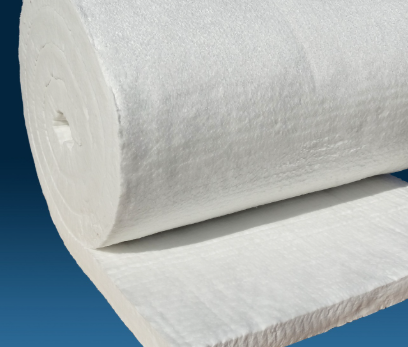
1. Raw materials: Primarily composed of alumina (Al₂O₃) and silica (SiO₂); high-end grades incorporate zirconia (ZrO₂).
2. Manufacturing process: Raw materials are melted and converted into fibers via spinning or blowing, then formed through double-sided needle-punching; the process involves no organic binders, ensuring no smoke emission or pulverization at high temperatures.
3. Form: White, flexible rolled matting; standard densities range from 96 to 160 kg/m³ and thicknesses from 6 to 50 mm; it can be easily cut, bent, and fitted to curved surfaces.
4. Key positioning: A Class A1 non-combustible material designed for high-temperature insulation, fire-resistant sealing, and furnace lining insulation; it serves as a replacement for heavy refractory bricks, significantly reducing weight.
Advantages of Ceramic Fiber Blanket
1. High-temperature resistance and exceptional thermal stability:
Suitable for long-term use at temperatures ranging from 950°C to 1350°C; resistant to thermal shock—it does not crack or spall during rapid temperature fluctuations and withstands repeated thermal cycling.
2. Outstanding thermal insulation and energy-saving performance:
Features extremely low thermal conductivity (≤0.22 W/(m·K) at 1000°C) and low heat capacity; reduces heat loss by 30%–40% compared to refractory bricks, significantly lowering energy consumption.
3. Lightweight, flexible, and easy to install:
Weighs only one-tenth of refractory bricks; inherently flexible, allowing it to be cut and wrapped around pipes or complex furnace shapes without complex masonry work, resulting in shorter installation times; needle-punched structure ensures high tensile strength and resistance to delamination or shedding.
4. Excellent chemical stability:
Resistant to corrosion from neutral substances, weak acids/alkalis, and oil/gas; damaged only by hydrofluoric acid or concentrated strong alkalis; insulation performance is fully restored after drying if contaminated with oil.
5. Fire-resistant, sound-absorbing, safe, and eco-friendly:
Completely non-combustible and smoke-free with a high fire-resistance rating; provides high-temperature sound absorption and noise reduction; contains no asbestos or toxic binders.
6. Versatile application:
Can be used directly as a lining or processed into refractory modules, folded blocks, gaskets, and fire-resistant sealing materials.
Main Types of Ceramic Fiber Blanket
Applications of Ceramic Fiber Blanket
1. Industrial High-Temperature Kilns and Furnaces (Primary Application):
Heat treatment furnaces, annealing furnaces, ceramic/brick kilns, glass furnaces, forging furnaces, and tempering furnaces; used for furnace wall linings, back-linings, door linings, roof linings, and expansion joint seals; can be processed into folded modules for monolithic furnace linings.
2. Power and Energy Industries:
Insulation for power plant boilers, gas turbines, steam turbines, waste heat recovery boilers, high-temperature flue ducts, and nuclear power equipment.
3. Petrochemical Industry:
Insulation for high-temperature reactors, cracking furnaces, heating pipelines, and high-temperature oil/gas transport lines to prevent heat loss and external surface burns.
4. Metallurgy and Metal Processing:
Back-lining insulation for steel ladles, aluminum melting furnaces, and medium-frequency furnaces; insulation for high-temperature metal heat treatment equipment.
5. Construction and Fire Protection:
Firewalls for high-rise buildings, fire-resistant wrapping for cable trays, fire-stop sealing, insulation for fire escape routes, and base material for fire blankets.
6. Other Specialized Applications:
(1). High-temperature gaskets, sealing packing, and thermal insulation buffer pads;
(2). Insulation for high-temperature equipment, ovens, pizza ovens, and industrial drying ovens;
(3). Thermal insulation for high-temperature equipment in marine, aerospace, and defense sectors;
(4). Linings for high-temperature filtration and sound absorption/noise reduction.
If you would like to find out more about ceramic fiber blankets, please contact us at export@weitengroup.com, www.weitengroup.com.
MOBILE / WHATSAPP86-18561739639
ADDRESSNo.27, Baoyuan Rd, Gaoxin District, Qingdao,China.
 WEITEN GROUP
Copyright © 2026 by WEITEN GROUP All Rights Reserved Designed by HUISHANG MEDIA