
1. Basic Concepts
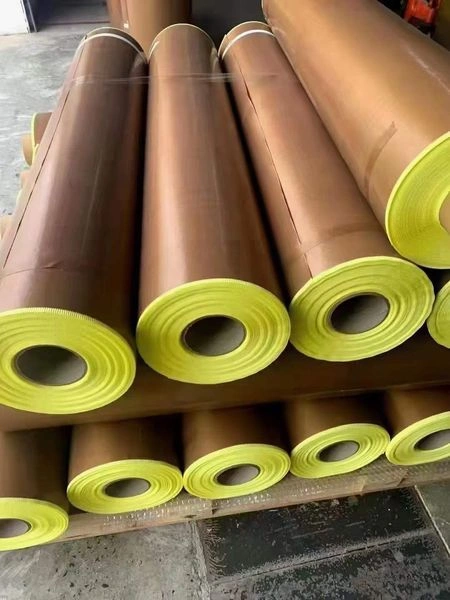
PTFE-coated fiberglass cloth—fully known as polytetrafluoroethylene-coated fiberglass fabric—is a high-performance composite material that combines the strength of fiberglass with the low-friction, non-stick, and corrosion-resistant properties of PTFE. Its core structure consists of a high-strength fiberglass fabric substrate that is thoroughly impregnated with PTFE emulsion (commonly known as the "King of Plastics") and subsequently processed through drying and high-temperature sintering.
2.Advantages of PTFE-coated fiberglass fabric
TExtremely wide temperature resistance range: It allows for long-term continuous operation between -70°C and +260°C; it can withstand temperatures up to 350°C for short periods and does not become brittle in extreme cold as low as -180°C. Even after continuous exposure to 250°C for 200 days, its strength and weight remain virtually unchanged.
Excellent non-stick properties and low friction: It is resistant to adhesion by almost all substances and is very easy to clean. Additionally, it features a very low coefficient of friction (0.05–0.1), making it an ideal oil-free, self-lubricating material.
Robust chemical stability: It withstands the vast majority of chemical corrosives, including strong acids, strong alkalis, aqua regia, and various organic solvents.
Outstanding physical and electrical properties: The material offers excellent dimensional stability (elongation coefficient of less than 0.5%) and high strength, while also providing high insulation, UV resistance, and flame-retardant characteristics. It also possesses a light transmission rate of approximately 6% to 13%.
3.Main Types of PTFE-coated fiberglass fabric
PTFE-coated fiberglass fabric has a wide range of applications, which can be broadly categorized into the following fields:
1. Industrial Conveying and Heat-Resistant Protection
This is one of its core applications. In industrial settings, it is frequently used to manufacture conveyor belts for various drying machines—such as those found on production lines for food baking, textile drying, or rubber vulcanization—leveraging its high-temperature resistance and non-stick properties to ensure materials pass smoothly through ovens. Additionally, it serves as a high-temperature pipe wrapping material or as an anti-stick barrier between mechanical components, protecting equipment surfaces from contamination by adhesives or resins.
2. Food Processing and Packaging
Thanks to its non-stick nature and compliance with food safety standards, it is widely used in the food industry. Examples include liners for ovens and microwaves, or sheets placed on baking trays; these prevent food from sticking and are easy to clean, avoiding the rust or food-adhesion issues common with metal baking trays.
3. Electronic and Electrical Insulation
In the electronics sector, it is used for high-performance insulation gaskets and separators, or for wrapping cables to provide heat resistance and electrical insulation. It also serves as a key substrate for manufacturing high-frequency copper-clad laminates used in high-performance circuit boards.
4. Construction and Outdoor Facilities
In construction, it is commonly used as a roofing material for membrane structures in large stadiums, railway stations, and airports. The material is weather-resistant, UV-resistant, and flame-retardant, while also offering a degree of light transmission that allows soft natural light to enter; furthermore, its excellent self-cleaning properties mean that rainwater can wash away most accumulated dust.
5. Plastic and Textile Machinery
In plastic welding processes, it acts as a welding cloth to prevent molten plastic from adhering to heating tools. In the textile printing and dyeing industry, it is used as a covering for the heat-pressing tables of transfer printing machines or wrapped around the rollers of sizing machines; in these roles, it provides anti-stick and heat-resistant functions, ensuring the fabric surface remains smooth and flat.
If you would like to find out more about PTFE-coated fiberglass fabric, please contact us at weiten@weitengroup.com, wwww.weitengroup.com.
MOBILE / WHATSAPP86-18561739639
ADDRESSNo.27, Baoyuan Rd, Gaoxin District, Qingdao,China.
 WEITEN GROUP
Copyright © 2026 by WEITEN GROUP All Rights Reserved Designed by HUISHANG MEDIA