
Those unfamiliar with valves might assume that installation is a trivial task; however, the reality is quite the opposite—valve installation requires great care and attention to detail. Below is a brief overview of nine common mistakes made during valve installation:
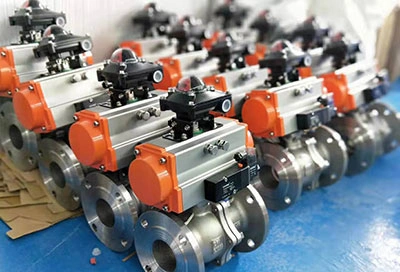
9 Common Mistakes in Valve Installation
1. Bolts that are too long. For valve bolts, having just one or two threads extending beyond the nut is sufficient; this minimizes the risk of damage or corrosion.
2. Failure to provide separate isolation for control valves. Although isolation valves take up valuable space, they are crucial for allowing personnel to perform maintenance work on the valve when needed. If space is limited and a gate valve is considered too long, a butterfly valve should be installed instead, as it occupies almost no space.
3. Failure to install pressure gauges or monitoring devices. While not strictly mandated, designing the system to allow for the monitoring of actual valve pressure is best practice. Some utility providers facilitate this by including connection points for field personnel to attach testing equipment.
4. Insufficient installation space. If installing a valve station involves complex work—such as concrete excavation—do not attempt to cut costs by minimizing the installation footprint. Doing so makes routine maintenance extremely difficult later on. Also, remember to account for tool length; adequate clearance must be provided to allow for loosening bolts.
5. Failure to consider future disassembly. If components are tightened too closely without any clearance, separating them later becomes nearly impossible. Proper spacing is essential, whether using grooved couplings, flanged joints, or pipe unions. Future component removal may be necessary; while this might not be a primary concern for the installation contractor, it is a critical consideration for the owner and engineer.
6. Horizontal installation of concentric reducers. Eccentric reducers are suitable for horizontal installation, whereas concentric reducers are designed for vertical lines. In applications requiring horizontal installation, an eccentric reducer should be used.
7. Valve vaults lacking drainage. Even during valve startup—such as when air is vented from the bonnet—water will inevitably spill onto the floor. If a drain pipe cannot be installed, a simple sump pump should be used, provided a power source is available. Even without an external power source, a float valve equipped with an ejector effectively keeps the chamber dry.
8. Failure to vent air. When pressure drops, air is released from the fluid and enters the piping, potentially causing issues downstream. A simple air release valve eliminates trapped air and prevents downstream problems—such as instability caused by air in the pilot lines; installing an air release valve upstream of the control valve is also effective.
9. Spare connection ports. This setup facilitates future maintenance, whether for connecting hoses, adding remote sensing to the control valve, or installing a pressure transmitter for SCADA systems. The minor cost of adding these fittings during the design phase significantly enhances future usability. Conversely, poor installation—such as covering everything in paint—makes maintenance difficult by obscuring nameplates and preventing necessary adjustments.
Proper valve installation ensures convenience in operation, whereas incorrect installation leads to endless trouble. Therefore, it is crucial to avoid the nine common mistakes mentioned above. For more information on valves, please visit the WEITEN Valve official website at www.weitengroup.com.
MOBILE / WHATSAPP86-18561739639
ADDRESSNo.27, Baoyuan Rd, Gaoxin District, Qingdao,China.
 WEITEN GROUP
Copyright © 2026 by WEITEN GROUP All Rights Reserved Designed by HUISHANG MEDIA