
Valves are commonly manufactured using materials such as stainless steel, brass, cast iron, and others. However, upon closer inspection, one finds that the bolts used in these valves are almost invariably made of stainless steel. If you look carefully, you will notice numbers inscribed on them—such as 4.6, 4.8, 5.6, 6.8, and so on. Why are these numbers present, and what significance do they hold?
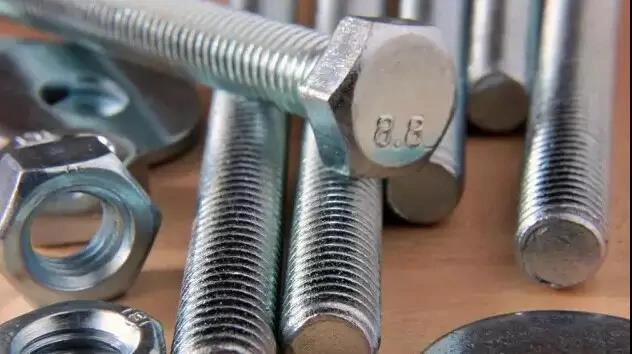
First, a bolt's performance grade designation consists of two numerical components. These numbers represent, respectively, the nominal tensile strength of the bolt material and its yield-to-tensile ratio. For example:
For a bolt with a performance grade of 6.8, the designation signifies the following:
1. The nominal tensile strength of the bolt material reaches the 600 MPa level;
2. The yield-to-tensile ratio of the bolt material is 0.8;
3. The nominal yield strength of the bolt material reaches the level of 600 × 0.8 = 480 MPa.
Specifically, bolts with a performance grade of 8.8 or higher are manufactured from low-carbon alloy steel or medium-carbon steel that has undergone heat treatment (quenching and tempering); these are collectively referred to as "high-strength bolts." The remaining grades are generally classified as "ordinary bolts." For high-strength bolts with a performance grade of 10.9, the material—after undergoing heat treatment—achieves a strength level of 900 MPa, calculated according to the method described above.
These bolt performance grade designations adhere to internationally recognized standards. Consequently, bolts of the same performance grade—regardless of their specific material composition or country of origin—will exhibit identical mechanical properties.
A specific distinction regarding strength classification applies to grades 8.8 and 10.9: these numbers specifically indicate that the bolt's shear stress resistance level corresponds to 8.8 GPa and 10.9 GPa, respectively.
Grade 8.8: Nominal tensile strength is 800 N/mm²; nominal yield strength is 640 N/mm².
Generally, bolt strength is denoted by the format "X.Y." The value X × 100 represents the bolt's tensile strength, while X × 100 × (Y/10) represents the bolt's yield strength (based on the standard marking convention, wherein the ratio of yield strength to tensile strength equals Y/10). For example, in the case of a Grade 4.8 bolt: its tensile strength is 400 MPa, and its yield strength is 400 × 8/10 = 320 MPa.
Note: Stainless steel bolts are typically designated as A4-70.
Generally, screws are specified by their nominal thread diameter multiplied by their length.
Regarding nominal thread diameters, common metric sizes include: M2, M3, M4, M5, M6, M8, M10, etc.
Common American (Imperial) sizes include: 4#-40, 6#-32, 8#-32, 10#-24, 1/4-20, 5/16-18, 3/8-16, etc.
Screw Length: This refers to the effective length embedded within the object being fastened. For instance: for countersunk screws, the specified length refers to the total length; for semi-countersunk screws, the length of half the head must be added; whereas for cylindrical head (socket head cap) screws, the length does not include the dimensions of the head itself. Furthermore, when specifying dimensions, it is best to include the thread pitch in the full designation. For example, in the specification M4-0.7×8: "4" indicates an outer thread diameter of 4 mm; "0.7" indicates a distance of 0.7 mm between two adjacent thread crests (the pitch); and "8" indicates an effective embedded length of 8 mm.
If you would like to find out more about valves or purchase other products, please contact us at fluid@weitengroup.com, wwww.weitengroup.com.
MOBILE / WHATSAPP86-18561739639
ADDRESSNo.27, Baoyuan Rd, Gaoxin District, Qingdao,China.
 WEITEN GROUP
Copyright © 2026 by WEITEN GROUP All Rights Reserved Designed by HUISHANG MEDIA