
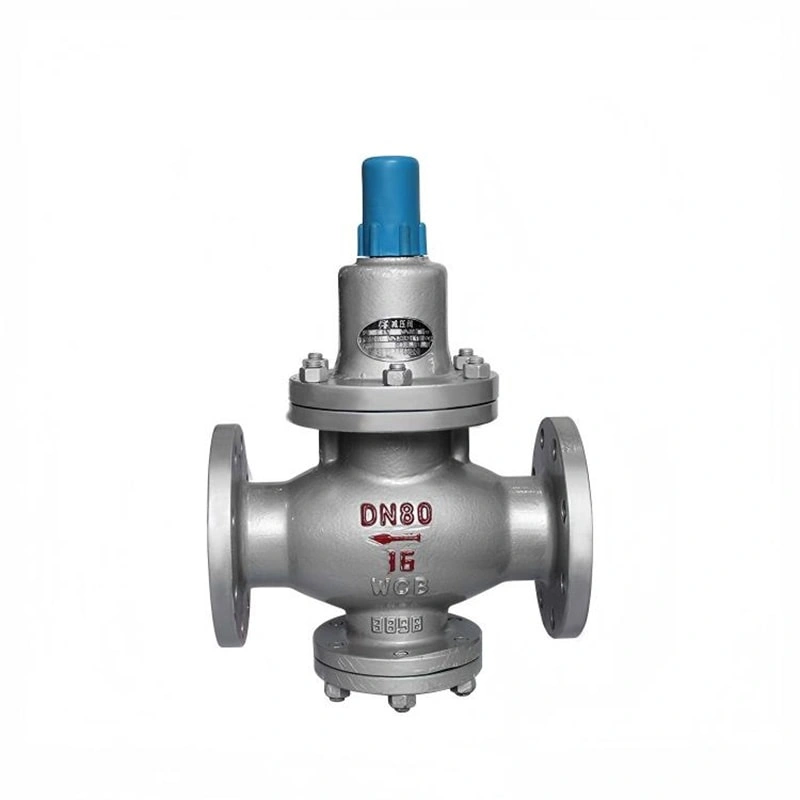
Pressure gauges are among the most commonly used accessories for pressure reducing valves. Taking WEITEN pressure reducing valves as an example, almost all models come equipped with a built-in pressure gauge to facilitate the real-time reading of pipeline pressure values. So, how should one go about selecting the appropriate pressure gauge? We provide a detailed guide below.
Pressure measuring instruments must strictly utilize statutory units of measurement—specifically: Pascals (Pa), Kilopascals (kPa), and Megapascals (MPa).
For pressure reducer design projects involving international contexts, internationally recognized standards or corresponding national standards may be adopted.
When implementing these regulations, compliance with all currently applicable national standards is also required.
Selection Based on Operating Environment and Nature of the Measuring Medium
1. For harsh environments, characterized by strong atmospheric corrosiveness, high dust levels, or the potential for liquid splashing, the appropriate casing material and protection rating (IP rating) should be selected based on the specific environmental conditions.
2. For the measurement of general media:
(1) When the pressure falls within the range of -40 kPa to +40 kPa, capsule pressure gauge is recommended.
(2) When the pressure exceeds +40 kPa, Bourdon tube pressure gauge or a bellows pressure gauge is generally selected.
(3)When the pressure falls within the range of -100 kPa to +2400 kPa, compound pressure-vacuum gauge should be selected.
(4) When the pressure falls within the range of -100 kPa to 0 kPa, Bourdon tube vacuum gauge is recommended.
3. For media such as dilute nitric acid, acetic acid, and other generally corrosive substances, acid-resistant pressure gauge or a stainless steel diaphragm pressure gauge should be selected.
4. For media such as dilute hydrochloric acid, gaseous hydrogen chloride, heavy oils, and similar substances that are highly corrosive, contain solid particles, or are highly viscous, diaphragm pressure gauge should be selected. The material used for the diaphragm must be chosen specifically based on the characteristics of the measuring medium.
5. For media prone to crystallization, scaling (fouling), or high viscosity, flange-type diaphragm pressure gauge should be selected.
6. For environments subject to significant mechanical vibration, vibration-resistant pressure gauge or a marine-grade pressure gauge should be selected.
7. In flammable or explosive environments, if an electrical contact signal is required, an explosion-proof pressure controller or an explosion-proof electrical contact pressure gauge should be selected.
7. For pressure gauges used to measure high or medium pressures, or highly corrosive media, it is advisable to select gauges featuring a housing equipped with an over pressure relief mechanism.
If you would like to find out more about valves or purchase other products, please contact us at fluid@weitengroup.com, wwww.weitengroup.com.
MOBILE / WHATSAPP86-18561739639
ADDRESSNo.27, Baoyuan Rd, Gaoxin District, Qingdao,China.
 WEITEN GROUP
Copyright © 2026 by WEITEN GROUP All Rights Reserved Designed by HUISHANG MEDIA